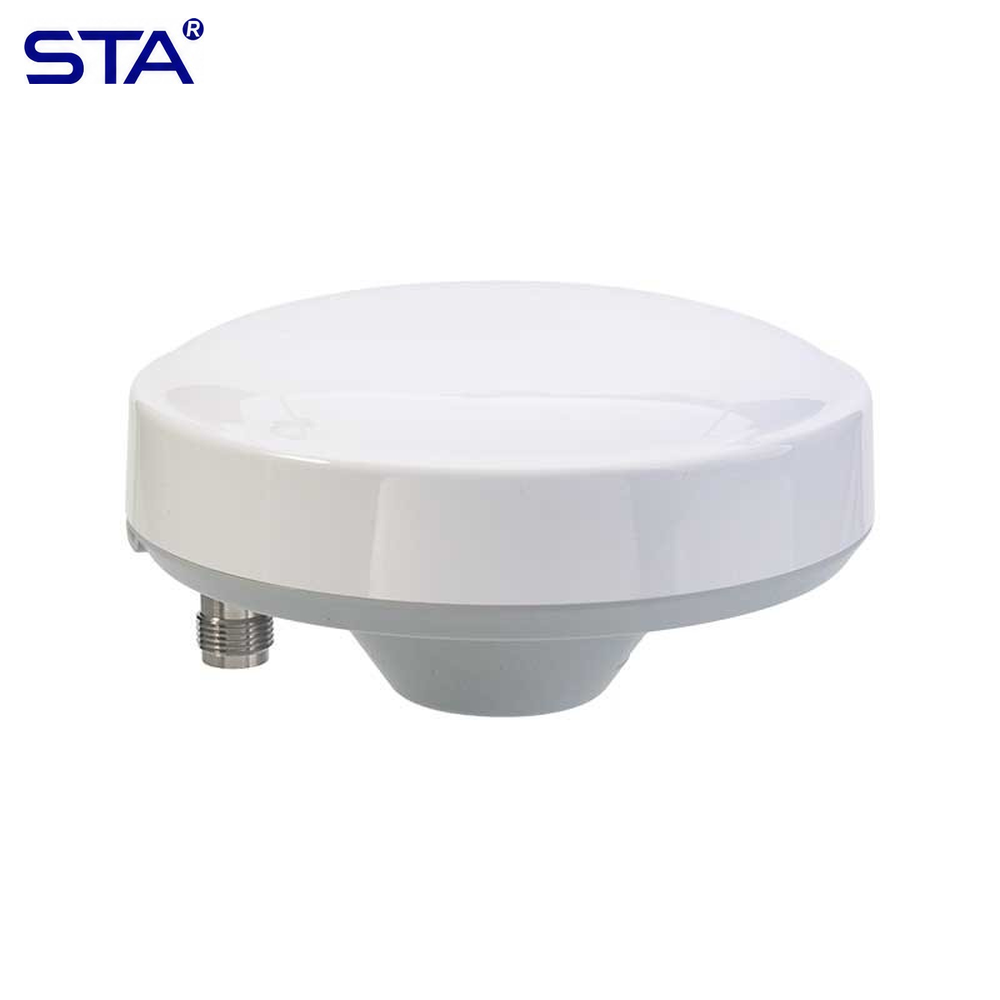
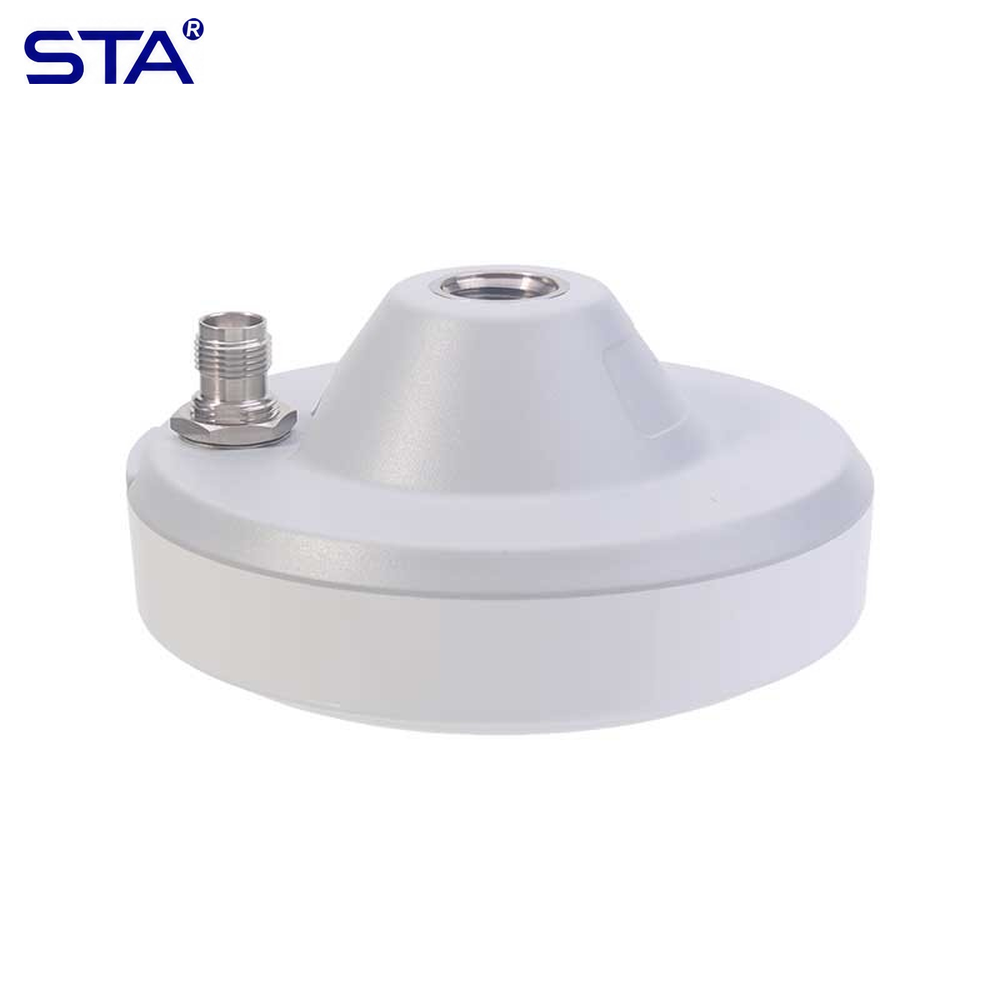
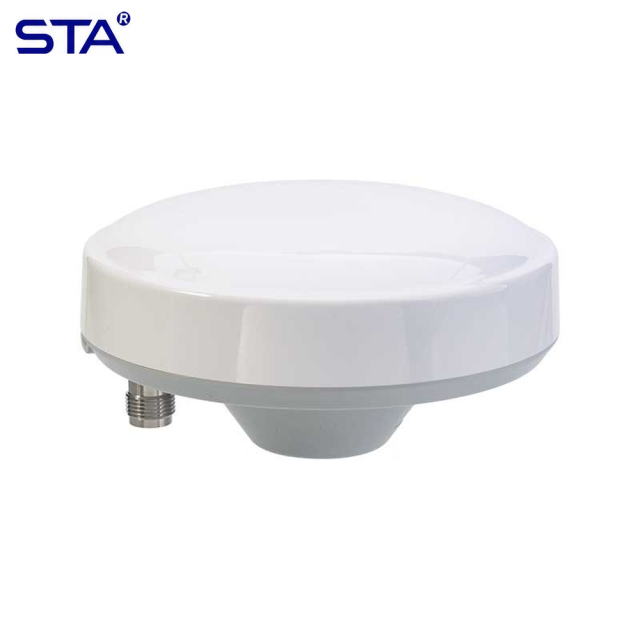
STA-106 Ultra-Lightweight Full-Frequency GNSS Surveying Antenna | L-Band & PPP Precision Ready
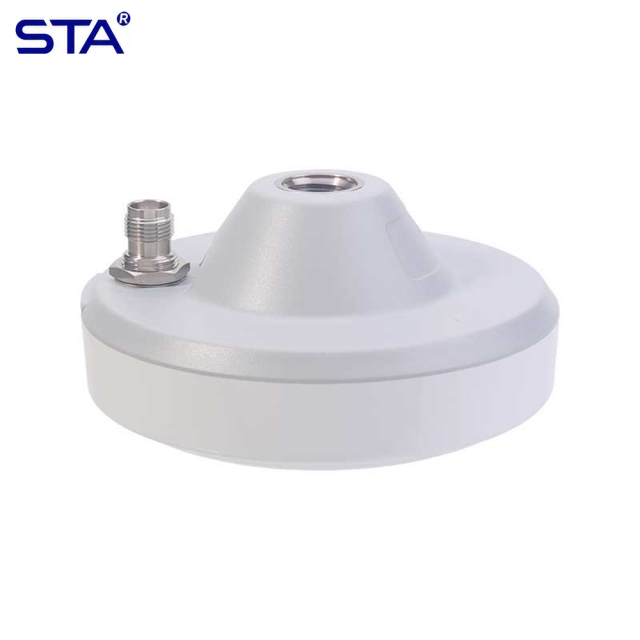
The STA-106 is a next-generation, high-precision GNSS surveying antenna defined by its ultra-compact form factor and multi-constellation brilliance. Shifting away from heavy, traditional geodesic antennas, the STA-106 features an aerodynamic diameter of just 106mm and a feather-light weight of under 260g. It is purpose-built for payload-sensitive applications like UAV LiDAR mapping, portable RTK rover poles, and robotic autonomous navigation.
Despite its compact shell, it delivers full-band tracking that includes L-Band signals and advanced frequencies like GLONASS G3 and Galileo E6. This empowers surveyors to utilize Precise Point Positioning (PPP) and star-based augmentation networks, achieving centimeter-level accuracy in remote regions completely cut off from cellular CORS base stations.
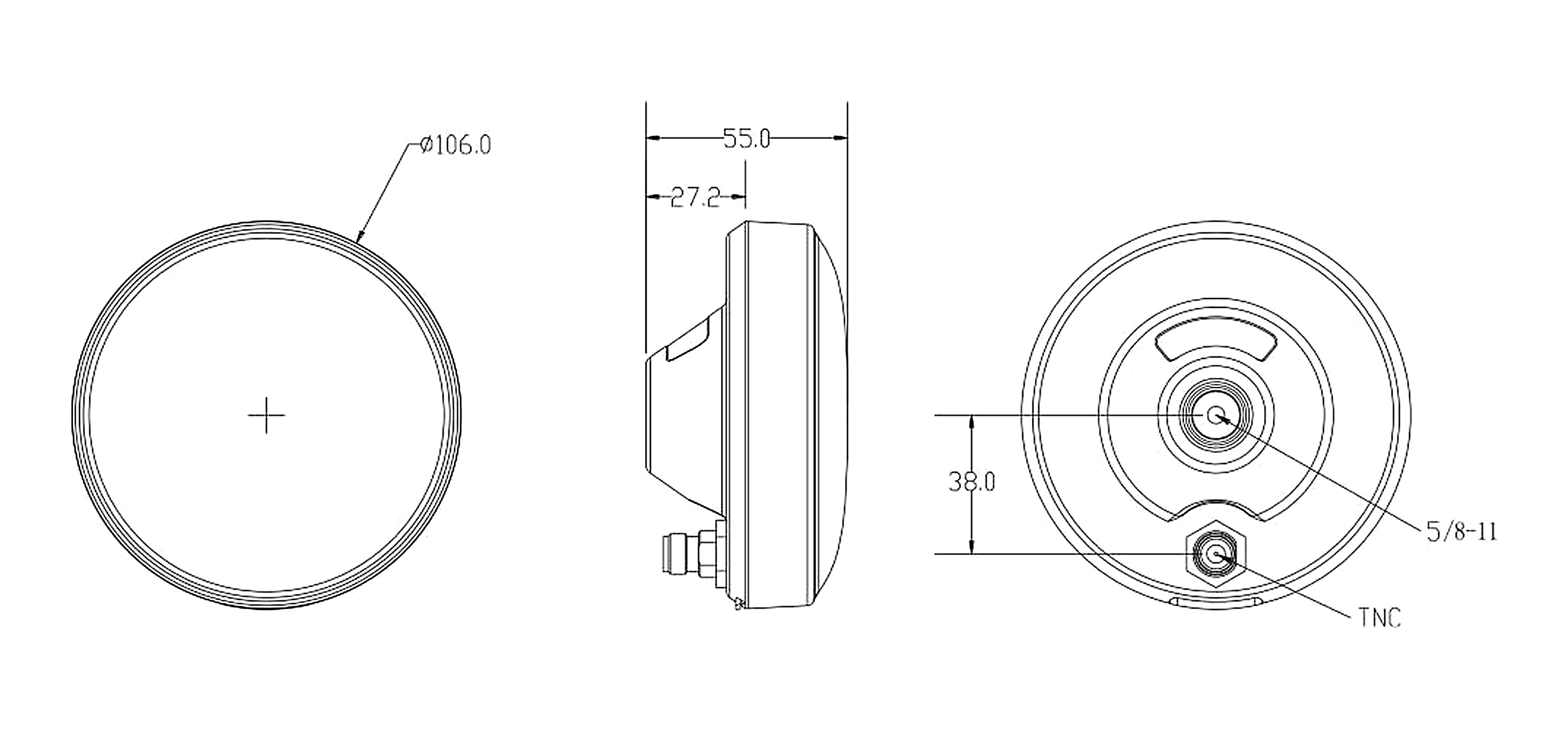
STA-106 Full-Frequency GPS Antenna 2D Drawing
Product Code
| STA Selection Code |
Product Name |
Frequency Range |
| STA-106 Antenna |
Full-Frequency GNSS Measurement Antenna |
GPS(L1、L2、L5);BD(B1、B2、B3);GOLNASS(L1、L2);Galileo(L1、E5b、E5a) |
| STA-106 Antenna+SMA Cable |
STA-45H Full-Frequency GNSS Antenna + 5M SMA Cable |
SMA Male to SMA Male with RG58/LMR200/240 Cable, Length=3M(Can be Customized) |
| STA-106 Antenna+TNC Cable |
STA-45H Full-Frequency GNSS Antenna + 5M TNC Cable |
TNC Male to TNC Male with RG58/LMR200/240 Cable, Length=3M(Can be Customized 1M,2M,3M) |
| Antenna Characteristics |
LNA Specs |
| Frequency Range |
GPS L1/L2/L5
BDS B1I/B2I/B3I/B1C/B2a/B2b
GLONASS L1/L2/L3
GALILEO E1/E5a/E5b/E6
QZSS L1/L2/L5/L6
IRNSS L5 L-Band
|
Gain |
L1: 34±2dBi
L2: 36±2dBi |
| Impedance |
50 Ω |
Noise Figure |
≤2dB |
| Polarization Type |
RHCP |
Output VSWR |
≤2.0 |
| Antenna Axial Ratio |
<3dB |
In-band flatness |
±2dB |
| Horizontal Coverage Angle |
360° |
Working Voltage |
+3.3~12VDC |
| Output VSWR |
<2.0 |
Working Current |
≤45mA |
| Maximum Gain |
5dBi |
Differential Delay |
<5ns |
| Phase Center Error |
±2mm |
|
|
| Structural Characteristics |
Working Condition |
| Operating temperature |
-40℃ ~ +85℃ |
Storage Temperature |
-55℃ ~ +85℃ |
| Connector Type |
TNC Female (Connector) |
Humidity |
95% non condensing |
| Installation Method |
Installation of centering rod, thread specification: British coarse thread 5/8 "-11, height 12-14mm |
VSWR |
≤2.0 |
Key Features & Technical Advantages
-
The 106mm Lightweight Standard: Weighing less than 260g, it drastically reduces carrier fatigue on manual survey rods and preserves battery flight metrics when mounted on multi-rotor commercial drones.
-
L-Band & Star-Base Augmentation Capable: Natively tracks L-Band frequencies alongside Galileo E6 and GLONASS G3, supporting real-time PPP algorithms for global, infrastructure-free positioning.
-
Energy-Optimized Active LNA Layout: Built with a highly responsive 39±3 dB low-noise amplifier that consumes ≤20mA of current. This low-power footprint makes it highly compatible with handheld controllers and battery-restricted sensor arrays.
-
Wide Voltage Adaptability (3.0~16VDC): Offers immense electrical flexibility, protecting the internal microstrip array against voltage drops or surges common in industrial and robotic circuitry.
-
Rugged IP67 Die-Cast Enclosure: Fully sealed against water immersion and localized dust storms, rated to operate flawlessly within a brutal industrial temperature window of -40℃ to +85℃.
Applications & Use Cases
- UAV Photogrammetry & LiDAR Mapping: The perfect airborne RTK/PPK antenna where every gram of weight directly translates into extra drone flight time.
- Handheld & Portable RTK Rovers: Integrates beautifully with compact GIS data collectors and carbon-fiber survey poles for urban cadastral mapping.
- Marine Hydrography & Coastal Drone Boats: The IP67 chassis combined with a standard 5/8"-11 survey thread ensures steady tracking on autonomous bathymetric survey vessels.
Frequently Asked Questions (FAQ)
Q1: Why is the STA-106 antenna categorized as an "L-Band Ready" device, and why does it matter?
A: Traditional RTK antennas require a localized base station or cellular RTK network to correct positional drift. The STA-106 is engineered with specialized wideband microstrip elements that track L-Band satellite corrections. This allows the hardware to utilize star-based correction services (PPP), providing decimeter-to-centimeter accuracy anywhere on Earth—even in oceans, deserts, or deep mountains without internet.
Q2: How does the weight and size of the STA-106 improve drone (UAV) mapping efficiency?
A: Standard surveying antennas usually exceed 400g to 500g, which strains drone motors and cuts flight limits short. The STA-106 breaks this bottleneck by compressing the geometry to a Φ106mm layout weighing less than 260g. It slashes payload mass by nearly 50% while maintaining a standard 5/8"-11 thread mount, ensuring professional-grade data quality without taxing the aircraft.
Q3: Is the ≤20mA current consumption significant for remote environmental telemetry?
A: Yes, absolutely. For solar-powered data logging systems, geological landslide tracking points, or battery-operated field rovers, power efficiency is critical. The STA-106 draws less than 20mA—half the power of traditional 45dBi antennas—massively expanding system runtime while keeping the LNA gain strong at 39±3 dB.
Q4: Can STA customize the connector or cable pigtail if my drone controller doesn't use TNC?
A: As an independent, ISO9001-certified factory in China, STA specializes in the full production of RF connectors and coaxial cable networks. While the base STA-106 comes with a standard rigid TNC Female hub, we can provide customized internal low-loss cable assemblies that convert the output directly to SMA, MCX, or IPEX interfaces to seamlessly fit your specific OEM electronics package.